Pages

Powered By Blogger
Showing posts with label Bengalfiles. Show all posts

September 11, 2025

The Bengal Files: Fact, Fiction, and the Politics of Memory


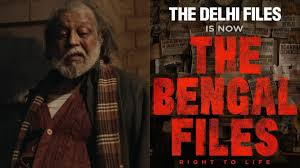
Cinema has always been more than entertainment in India—it is a weapon, a mirror, a battlefield of memory and imagination. With the rise of politically charged films like The Kashmir Files (2022), audiences have become accustomed to movies that claim to “unveil hidden truths” while in reality presenting a selective narrative. The upcoming The Bengal Files falls squarely into this category. Its title alone suggests a daring exposé, but the truth is far more complex: the film is not a faithful retelling of historical fact, but rather a fictionalized, politically loaded narrative woven out of real fragments of Bengal’s history.

To understand where The Bengal Files stands between reality and imagination, one must first revisit the turbulent history of West Bengal.


The Historical Backdrop of Bengal

Bengal has never been free from turmoil. Partition in 1947 tore the region apart, dividing Bengal into West Bengal (India) and East Bengal (later East Pakistan, and after 1971, Bangladesh). The scars of Partition—displacement, refugee suffering, and communal violence—continue to shape Bengal’s collective memory.

In 1971, the Liberation War in East Pakistan triggered another massive influx of refugees into West Bengal, aggravating communal and economic tensions. This was followed by decades of political upheaval: from the Naxalite movement of the late 1960s to the long rule of the Communist Party of India (Marxist), and eventually the rise of the Trinamool Congress. Each regime carried with it its share of controversies, allegations of violence, and authoritarianism.

So yes, Bengal’s history is soaked in trauma. But that trauma is complex, layered, and often entangled with questions of class, caste, ideology, and migration—not the simplistic victim-perpetrator binaries that films like The Bengal Files tend to present.


What the Film Might Claim


From its title and early buzz, The Bengal Files positions itself as a revelation of “suppressed truths.” It seeks to emulate the formula of The Kashmir Files, which dramatized the 1990 exodus of Kashmiri Pandits but also faced sharp criticism for communal overtones and selective storytelling.

Similarly, The Bengal Files may highlight:

  • Political violence in Bengal, often bloody and ruthless.
  • Communal tensions, portrayed as systematic persecution.
  • Illegal immigration from Bangladesh, framed as a demographic threat.
  • Government complicity or apathy, a favorite trope in films meant to showcase victimhood.

But are these depictions factually accurate? Not entirely.


The Reality Behind the Fiction

Political Violence – True, but Misrepresented

It is undeniable that Bengal has seen decades of political bloodshed. From the 1970s “Syndicate Raj” of the CPI(M) to today’s TMC-BJP clashes, stories of murders, booth-capturing, and intimidation are common. In fact, post-poll violence in 2021 drew national attention and even reached the Supreme Court.

Yet, portraying this as a targeted extermination of one community by another oversimplifies the truth. Much of Bengal’s violence is political, not communal. Villages are divided along party lines, not strictly religious ones. This distinction is crucial but is likely to be blurred in the cinematic portrayal.

Communal Tensions – Historical, but Localized

Bengal has witnessed several communal riots: the infamous Noakhali riots of 1946, clashes during Partition, sporadic incidents in the 1980s, and more recent flare-ups in places like Basirhat (2017) and Howrah (2023). However, these incidents, tragic as they are, do not add up to an organized, long-term “genocide” as some film narratives suggest. They were localized, politically manipulated, and often quelled by state intervention.

Illegal Immigration – Politicized Reality

Migration from Bangladesh is indeed a sensitive issue. For decades, porous borders have allowed inflows, leading to social and political anxieties. Both the Left and the Trinamool governments have been accused of turning a blind eye for vote-bank politics. The BJP has weaponized this issue nationally through the NRC (National Register of Citizens) debate.

But again, cinema exaggerates. What is a complex mix of economics, identity, and politics may be shown as a one-dimensional “invasion” story, fitting neatly into majoritarian anxieties.

Partition Memories – Selectively Highlighted

No other region in India has been so deeply marked by Partition as Bengal. Families torn apart, Hindu refugees settling in colonies, Muslims migrating eastward—this trauma is real and well-documented. A nuanced film on Partition would be a valuable contribution. Unfortunately, The Bengal Files is unlikely to present nuance. It may cherry-pick refugee stories that fit its desired narrative while erasing others.


Where Fiction Takes Over

What distinguishes propaganda cinema from serious historical drama is not what it includes but what it excludes. The Bengal Files may speak of Hindu suffering but ignore Muslim victimhood during the same periods. It may present Bengal’s ruling parties as villains but leave out the violence committed by its own ideological patrons.

The “files” device is a cinematic gimmick. There are no secret archives suddenly revealing suppressed truths; history is available in libraries, court judgments, and academic research. What these films do is not “uncover” but “repackage”—repackage memory into a simplified, emotional, and politically useful story.


Why Now? The Political Timing

No film of this kind is released in a vacuum. The Bengal Files aligns neatly with ongoing political battles:

  • The BJP’s attempts to expand its base in Bengal.
  • The debate over illegal immigration and NRC.
  • The need to present Bengal as a site of Hindu victimhood, paralleling the Kashmir narrative.

The timing, therefore, is not cultural but electoral.


Cinema as a Tool of Polarization

One cannot deny the emotional power of such films. They strike at identity, grievance, and victimhood. Audiences leave theaters not merely entertained but often agitated, convinced that history has been hidden from them and only now revealed.

But that conviction itself is the problem. Cinema is not history. Cinema is storytelling. When films like The Bengal Files blur the line between the two, they risk weaponizing memory for present-day politics.


The Real Bengal Story Deserves Better

Bengal’s story is not a single “file.” It is a vast archive of struggles—Partition, refugee crises, Naxalite uprisings, communist experiments, cultural renaissance, economic decline, and revival. Reducing all this into a communal narrative does injustice to Bengal’s people.

The truth is that both Hindus and Muslims, communists and nationalists, elites and peasants—all have been victims at different times in Bengal’s turbulent history. To erase this complexity is to erase Bengal itself.


Conclusion

The Bengal Files is not based on a singular true event. It borrows from real incidents—political violence, communal riots, migration issues—but stitches them into a fictionalized narrative designed to shock and polarize. While it may succeed at the box office and in political messaging, it will fail as history.

Bengal deserves cinema that captures its layered truth, not propaganda masquerading as revelation. The files that matter are not secret dossiers but the lived memories of millions—memories too complex to be reduced to a single, partisan script.


 Author: Siddhartha Shankar Mishra
Advocate, Supreme Court of India. Writes on law, politics, and society with a critical lens on propaganda, authoritarianism, and the misuse of history in public discourse.

Email : - ssmishra33@gmail.com 


July 20, 2025

How Propaganda Films Hijack the Indian Mind


The Cinematic Blueprint of Political Polarisation


When Joseph Goebbels declared that cinema was one of the most powerful weapons in the arsenal of the state, he was not being hyperbolic. As Nazi Germany perfected the art of propaganda, film became more than a medium of entertainment—it became an instrument of indoctrination. Almost a century later, the template remains eerily relevant. In democracies and autocracies alike, propaganda cinema continues to thrive, shaping public opinion, altering historical memory, and manipulating national consciousness.


The Craft of Conviction

At its core, a propaganda film does not merely present a narrative—it constructs a moral universe. Villains and heroes are painted in broad, unambiguous strokes. Complex socio-political realities are reduced to binary choices: nationalism versus anti-nationalism, civilization versus barbarism, us versus them. When such simplifications are backed by powerful imagery, emotive music, and gripping performances, the impact on the psyche of viewers can be profound.

Propaganda cinema cloaks itself in patriotism and purpose. It portrays dissenters as traitors, minorities as threats, and ideological opponents as enemies of the state. The intention is never just storytelling—it is nation-building, or more aptly, nation-moulding.


Yet, it is important to distinguish between dissent and hate. Not all political cinema is propaganda. Films like Kissa Kursi Ka (1977) and Aandhi (1975) questioned power and critiqued the system, but they did so without vilifying communities or weaponizing religion. They were voices of resistance in the truest democratic sense—satirical, symbolic, and aimed at the abuse of authority, not at inciting societal divisions. Unlike modern propaganda films, these classics did not seek to create an "enemy within." They questioned rulers, not citizens.


The Indian Context: Beyond Entertainment

In contrast, the recent surge in politically charged films such as The Kashmir Files, The Kerala Story, and the upcoming The Delhi Files marks a troubling evolution. These films do not merely reflect the political mood—they are part of the machinery shaping it. Wrapped in the language of "truth-telling" and "bringing hidden histories to light," such films often distort facts, cherry-pick incidents, and weaponize trauma.


Now, Vivek Agnihotri, the director of The Kashmir Files, is working on The Bengal Files, a film purportedly based on political violence in West Bengal. Given Agnihotri’s established pattern—where history is viewed through the lens of communal victimhood and ideological warfare—The Bengal Files appears less like investigative storytelling and more like the continuation of hate politics through cinema. The project, unveiled amid political turbulence in Bengal, seems poised to further polarize public opinion in a state already grappling with deep-rooted tensions. Its objective appears less about truth and more about reinforcing a national narrative of siege and division.


Follow the Money: Who’s Funding the Propaganda?

The success of these films isn't accidental—nor is their financing merely artistic. A closer look reveals an intricate ecosystem where ideology, money, and political power work hand in hand.

1. Producers with Political Links

Many of these films are backed by producers with visible or tacit ties to the ruling party.
The Kashmir Files, for example, was co-produced by Zee Studios and Abhishek Agarwal Arts—the latter run by a Hyderabad-based businessman known for his proximity to BJP leaders. The Kerala Story was produced by Vipul Amrutlal Shah, a filmmaker whose public statements often mirror Hindutva rhetoric.

2. Government Patronage as Indirect Funding

No government official writes a cheque—but support comes in subtler, more powerful forms:

  • Tax exemptions granted by BJP-ruled states,
  • Free screenings for students, police, and bureaucrats,
  • Public endorsements by top leaders including the Prime Minister,
  • And amplification by the BJP’s digital ecosystem, giving these films the kind of reach most filmmakers can only dream of.

Such soft backing dramatically reduces costs and guarantees attention—making it a kind of de facto state subsidy.

3. Shadow Funders and Ideological Venture Capital

A number of relatively unknown production houses have suddenly emerged with unexplained funding muscle. These are often linked to:

  • Real estate and mining interests,
  • Businessmen aligned with ruling party agendas,
  • Or shell companies connected to media empires sympathetic to the regime.

While direct evidence is scarce due to opaque financial structures, patterns of political timing and exclusive access to resources strongly suggest orchestrated support.

4. Ideologically Driven Directors

Directors like Vivek Agnihotri, who calls himself a “cultural warrior,” are no longer just storytellers—they are missionaries with a camera. His close appearances with RSS-affiliated organizations and ideological think tanks like India Foundation suggest that these films are not independent creations—they are commissioned narratives. The Bengal Files, in this context, appears not as journalism through art but propaganda through celluloid.


Cognitive Capture: The Mind as a Battlefield

A critical aspect of propaganda films is their ability to bypass critical reasoning. Neuroscience suggests that emotionally charged visuals activate the amygdala—the brain’s fear center—suppressing rational thought and enhancing memory retention. In other words, when a film shocks or angers us, it leaves a deeper impression than a news article or policy paper ever could.

This is particularly dangerous in a society where media literacy is low and cinema remains the most accessible form of mass communication. A citizen who watches a communal propaganda film may not consciously become prejudiced, but the seeds of bias are sown. Repetition, emotional manipulation, and social reinforcement (via WhatsApp forwards, social media memes, or television debates) water those seeds until they blossom into conviction.

What begins as “just a movie” soon becomes the basis of “I heard somewhere,” which hardens into “I know this happened.” The leap from perception to belief is barely noticed.


From Socio-Politics to Geopolitics

The domestic impact of propaganda films is grave, but their geopolitical implications are equally troubling. When films demonize an entire religion or community—be it Muslims in India, immigrants in the U.S., or Uyghurs in China—they don’t just influence internal discourse. They signal to the world a nation’s ideological trajectory.

India, once proud of its pluralism, now finds itself defending against charges of Islamophobia, partly because of the global reach of its domestic narratives. When state-backed or state-endorsed films project a unidimensional nationalism, it affects bilateral relations, diplomatic equations, and even trade alliances.

Moreover, authoritarian regimes have long understood the power of cinema in projecting soft power abroad. Russia, China, and Turkey have invested heavily in period dramas and nationalist blockbusters that export their worldview globally. The battle for narrative supremacy has moved beyond battlefields and boardrooms—it now plays out on Netflix, YouTube, and Prime Video.


The Fragile Viewer: Consent Without Awareness

Perhaps the most insidious feature of propaganda cinema is its subtle violation of the viewer’s consent. When we watch political speeches or campaign ads, we do so with a sense of guardedness, aware that persuasion is the intent. But cinema disarms us. We walk into a theatre seeking entertainment, not ideology. We let our guard down, suspend disbelief, and allow ourselves to be swept away.

This is precisely what makes propaganda films so effective: they do not argue, they hypnotize.

In a healthy democracy, films should provoke thought, not paralyze it. They should ask questions, not issue verdicts. When cinema begins to echo only one kind of nationalism, one kind of history, one kind of heroism—it ceases to be art and becomes artillery.


Conclusion: Between Truth and Trauma

As citizens, we must remain vigilant. Not all films are propaganda, and not all propaganda films wear the mask of nationalism. Sometimes, the bias is subtle—a line here, a stereotype there. Sometimes, it is blatant. But in every case, the effect is cumulative.

We must ask: Who made this film? Who funded it? Why now? Whose version of history is being told? What is being omitted? And what purpose does it serve?

Cinema has the power to heal, to build bridges, to imagine new futures. But when wielded irresponsibly, it can also inflame, divide, and destroy. A nation that treats film as a weapon rather than a mirror will eventually lose sight of its own reflection.


Author: Siddhartha Shankar Mishra is an Advocate at the Supreme Court of India. He writes on law, politics, and culture, often exploring the intersection between power and perception.