Pages

Powered By Blogger
Showing posts with label hatepolitics. Show all posts

January 11, 2026

When Faith Traveled: Islam’s Long Journey into India


The coming of Islam to India is often explained through only one lens, that of invasion and political conquest. This narrow view hides a far more complex and human story. Islam reached India through trade, travel, spiritual exchange and social transformation long before it arrived through armies. Conversions happened through many different processes, including voluntary acceptance, social mobility, spiritual attraction and community integration. To understand this history honestly, one must look at geography, economy, caste structure, politics and religious movements together.

Early Contact Through Trade on the Western Coast

India had strong maritime links with West Asia long before the birth of Islam. Arab traders were visiting ports of Kerala, Konkan and Gujarat for spices, pearls and textiles even in pre Islamic times. After the rise of Islam in the seventh century, these traders became carriers of the new faith along with their goods.

These merchants did not arrive as conquerors. They came as business partners. Many settled in coastal towns, married local women and became part of the social fabric. Over time, some local families adopted Islam through daily interaction, friendship and inter marriage. This process was slow and peaceful and happened across generations.

The Muslim community of Kerala known as Mappila Muslims is widely believed to have grown from these early contacts. Their culture shows deep local roots in language, food and social customs, proving that Islam in India adapted itself to regional life rather than replacing it.

The First Indian Traditionally Said to Accept Islam

According to long standing tradition in Kerala, a Chera ruler known as Cheraman Perumal is believed to be the first Indian to have accepted Islam. Popular accounts say that he traveled to Arabia, met Prophet Muhammad, accepted Islam and took the name Tajuddin. While returning to India he is believed to have died on the way, but before that he instructed that mosques be built on the Malabar coast.

Modern historians debate the historical certainty of this story because there is limited contemporary documentary proof. However, this tradition has deep cultural roots and is preserved in regional chronicles and Muslim community memory in Kerala. Whether fully historical or partly legendary, the story reflects early contact between India and the Islamic world through peaceful routes rather than military ones.

The First Mosque in India

The Cheraman Juma Mosque at Kodungallur in Kerala is traditionally regarded as the first mosque in India. It is believed to have been established around 629 CE by Malik bin Dinar, an early Muslim scholar who is said to have come to India along with other companions to spread Islamic teachings.

While historians debate the exact date of construction, there is broad agreement that some of the earliest mosques in India were built on the western coast through merchant communities and religious teachers, not through rulers or soldiers. Several mosques along the Malabar coast are linked by tradition to Malik bin Dinar and his companions, indicating that Islam spread in this region through spiritual networks and trade connections.

Entry Through Sindh and the First Political Rule

The first major political conquest by a Muslim ruler in the Indian subcontinent occurred in 712 CE when Muhammad bin Qasim defeated the ruler of Sindh. This brought parts of present day Pakistan under Muslim administration.

However, political control did not immediately result in mass religious conversion. Local populations largely continued practicing their own religions. The new rulers were more concerned with collecting revenue and maintaining stability than changing religious identity. Religious communities were allowed to manage their own institutions and customs.

This shows that political conquest and religious conversion did not always move together. The spread of Islam as a faith followed a different path from the spread of Muslim political power.

Expansion of Muslim Rule and Society in North India

From the eleventh century onward, various dynasties established Muslim rule over large parts of northern India, including the Delhi Sultanate and later the Mughal Empire. These periods saw warfare, destruction and political restructuring, but conversion was not consistently imposed as state policy.

Many Hindu elites served in courts, military and administration. Rulers were often more interested in loyalty and revenue than religious uniformity. While some rulers adopted stricter religious positions, others followed policies of tolerance and inclusion.

Conversion did occur during this period, but mostly through social processes rather than government orders. People converted for reasons ranging from spiritual belief to social opportunity.

The Powerful Role of Sufi Traditions

Perhaps the most important factor in the spread of Islam in India was the Sufi movement. Sufi teachers traveled widely across villages and towns, speaking local languages and living among common people. They preached devotion to God, humility, compassion and equality.

Sufi shrines became social centers where people of all religions gathered. Food was served freely and spiritual guidance was offered without discrimination. For many communities facing social exclusion under rigid caste structures, Sufi spaces offered dignity and belonging.

Conversion through Sufi influence was usually slow and emotional, based on personal trust and spiritual experience. This kind of conversion did not require rejection of local culture. Instead, many Sufi practices blended with regional music, poetry and customs.

Social and Economic Reasons Behind Conversion

Religion does not spread only through belief. It also spreads through social realities. In medieval India, caste divisions were harsh and deeply entrenched. For many lower status communities, conversion to Islam offered a way to escape inherited discrimination.

Islam taught formal equality among believers, at least in principle. This message was attractive to groups that faced social humiliation. Conversion also sometimes opened access to new occupations, military service and administrative roles.

In agricultural regions like Bengal and Punjab, conversion often occurred alongside settlement and farming expansion. New villages developed under Muslim landlords and over time religious identity shifted gradually rather than through sudden change.

This means conversion was often linked to everyday life decisions, not dramatic moments of religious coercion.

Was Conversion Ever Forced

History must be truthful. There were instances of coercion, destruction of religious sites and pressure to convert, especially during periods of war. Some rulers did use religion as a tool of power.

But forced conversion cannot explain the large Muslim population of India. If conversion had been mainly violent and systematic, resistance and revolt would have been constant and religious diversity would not have survived as it did.

Most historians agree that while violence occurred in specific contexts, the overall growth of Islam in India happened through social and cultural integration rather than constant compulsion.

Growth of Muslim Society Over Centuries

Once Muslim communities were established, they grew naturally through family life and community continuity. Over time, Islam became deeply Indian in language, food, dress and social behavior.

Bengali Muslims, Deccani Muslims, Kashmiri Muslims and Malayali Muslims developed distinct regional cultures. They spoke local languages, followed regional traditions and participated in local economies.

This shows that Islam did not remain an external identity. It became woven into the fabric of Indian society.

Timeline of Cultural Integration

Seventh to ninth century
Muslim traders settled in coastal towns. Mosques were built in local architectural styles. Arabic words entered local languages. Mixed families created blended traditions.

Tenth to twelfth century
Sufi teachers moved inland. Shrines became shared spiritual spaces. Devotional poetry developed in local languages. Islam spread through village level interaction.

Thirteenth to fifteenth century
Stable Muslim rule allowed social mixing. Persian influenced court culture shaped art and language. Indo Islamic architecture developed. Communities shared festivals and customs.

Sixteenth to eighteenth century
Mughal period saw cultural synthesis in painting, literature and music. Local languages absorbed Persian vocabulary. Social boundaries remained but cultural exchange flourished.

Nineteenth century onward
Colonial policies hardened religious identities. Census and political representation made religion a political category. Earlier fluid identities became rigid community labels.

Regional Patterns of Integration

In Kerala, Muslims followed matrilineal traditions in some communities and spoke Malayalam. Food and dress remained regional.

In Bengal, Islamic faith blended with folk culture and rural traditions. Bengali remained the primary language of religion and daily life.

In the Deccan, Dakhani language mixed Persian with Telugu and Marathi. Local food and clothing dominated daily life.

In Kashmir, Islamic traditions blended with earlier spiritual practices. Poetry and philosophy reflected both influences.

These examples show that Islam in India never erased regional identity. It absorbed it.

Modern Political Misuse of History

In present times, history is often simplified and used for political mobilization. Narratives of permanent conflict are promoted to divide communities. This ignores centuries of shared culture, mixed families and joint participation in economic and social life.

Most Indian Muslims are not descendants of foreign invaders. They are descendants of Indians who adopted Islam and remained rooted in their regions. Their culture, language and ancestry are Indian.

Recognizing this truth is essential for social harmony and constitutional values.

Understanding Conversion Without Fear

Conversion should not be seen only as loss or betrayal. Throughout history, people across the world have changed faiths in search of dignity, meaning and belonging. India itself has seen movements between religions for centuries.

Understanding this process does not weaken any religion. It strengthens social maturity by accepting that faith is deeply personal and historically complex.

Conclusion

Islam came to India not through one event but through many journeys. Traders brought it to the coast. Teachers carried it inland. Rulers established political structures. Communities adapted it to local life. Converts shaped it into regional cultures.

The story of Islam in India is not only about power. It is also about people, choices, relationships and shared history. It is part of the Indian story, not separate from it.

Reducing this long and layered history into slogans of invasion or victimhood serves politics, not truth. A mature society must face its past with honesty and confidence, not fear.


Author Introduction

Siddhartha Shankar Mishra is an advocate at the Supreme Court of India and a commentator on law, politics and society. His writings blend legal insight with social critique and aim to provoke reflection on power, justice and public conscience.

December 19, 2025

Hindu Hindutva and the Great Betrayal


The Rashtriya Swayamsevak Sangh RSS the ideological mothership of the BJP and its extended family of front organisations has performed one of the most cynical feats in modern Indian politics: the hijacking of a civilisational identity called Hindu and the conversion of it into a political war cry called Hindutva. This transformation has not just polarised India it has permanently altered the national character weaponising religion not for spiritual awakening but for electoral arithmetic and majoritarian muscle flexing.

Make no mistake: the word Hindu was never a religion to begin with. It was a geographical identity a loose term describing the people living east of the Sindhu Indus River. Over centuries it evolved into a mosaic of faiths practices contradictions and philosophies. A way of life some said. A civilisation others argued. But it was never a monolith and certainly never an ideology. That distortion that vile simplification came with Hindutva.

And who brought it The RSS. An organisation that sat out Indias independence movement. While Mahatma Gandhi was being arrested while Nehru was in jail and while countless Indians were laying down their lives for swaraj the RSS was busy doing drills in khaki shorts perfecting salutes and preaching cultural nationalism inspired not by Ashoka or Akbar but by Mussolini and Hitler.

Yes you read that right. The early Hindutva ideologues Savarkar Golwalkar Hedgewar looked to fascist Europe for inspiration. Golwalkar even praised Nazi Germanys race pride as a model for India to follow. These are not accusations these are documented facts buried deep in their writings and conveniently omitted from their propaganda.

Fast forward to today and you will see the same legacy playing out only this time with more money more media and more menace. The RSS and its political face the BJP have turned the Hindu Hindutva binary into a mass production factory of fear and fiction. Under the guise of cultural renaissance they have peddled myths revised history textbooks and reduced Indias rich diversity into an Us versus Them narrative.

Who is this Them Muslims Christians liberals dissenters anyone who questions their monopoly over nationalism or dares to see Hinduism as something deeper than temple photo ops and cow vigilantes. The irony is sharp: a movement that claims to protect Hinduism does not even understand it.

Let us talk plain. Hinduism is about questioning. About doubt debate dialectics. The Upanishads are not instruction manuals but conversations. The Gita is not a war mongering tract but a discourse on duty renunciation and inner conflict. The Rig Veda does not say my god is better than yours it says truth is one the wise call it by many names. Can this be the foundation of an exclusivist ideology Of course not.

But the Sangh does not care. Its project is not religious it is political. It does not want to protect Dharma it wants to consolidate votes. Its soldiers do not chant mantras they hurl abuse online and drag citizens out of trains for eating beef. The average RSS foot soldier is not meditating under a Bodhi tree he is manufacturing hate under a fake Twitter handle.

Look at how they operate: with slogans not substance. With symbols not spirituality. From Love Jihad to Ghar Wapsi from cow protection to Ram Mandir every issue is designed not to unite Hindus but to divide India. They promise cultural pride but deliver cultural paranoia. They invoke Bharat Mata but abuse her very ethos.

And what about the so called Hindu Rashtra they dream of A theocratic state run by scriptures and mob sentiment The idea itself is anti Hindu. Hinduism has survived precisely because it did not have a Pope a single Book or a rigid dogma. It allowed Buddha to challenge the Vedas Kabir to ridicule rituals and Meera to dance with her Krishna. Can the same tradition tolerate hate campaigns and moral policing Can it live under lynch mobs and textbook lies

Of course not. But these are inconvenient truths for the Sangh. So they whitewash history. They erase uncomfortable facts and rewrite the past as per their political convenience. Tipu Sultan becomes a tyrant Gandhi becomes irrelevant Ambedkar becomes a Hindu mascot and Savarkar becomes a reluctant patriot. This is not history it is fiction wrapped in saffron.

Worse the children of the very leaders who scream Bharat Mata ki Jai send their own kids to convent schools to Ivy League universities abroad to air conditioned enclaves of globalisation. The public is fed cow dung and WhatsApp forwards the private elite lives in gated hypocrisy.

And yet this con has worked. The RSS BJP machine has managed to convince a majority of Indians that being Hindu means hating the Other. That defending culture means destroying coexistence. That ancient India was some kind of golden theocracy that must be recreated through violence and exclusion.

It is the greatest betrayal of Hinduisms spirit and Indias soul.

It must also be said that the so called secular parties allowed this to happen. By appeasing the minorities in token ways and abandoning grassroots education they created a vacuum that the Sangh filled not with values but with venom. Where the Congress once promised Garibi Hatao the BJP today offers Muslim Hatao. The slogans have changed but the scam remains.

So where do we go from here

First we reclaim the difference between being Hindu and being Hindutvavadi. You can be a proud Hindu and reject the RSS. You can chant Om and oppose lynching. You can visit temples and still stand for constitutional rights. Do not let them tell you otherwise.

Second we must call out their hypocrisy. Loudly repeatedly and unapologetically. When a mob kills in the name of cows ask why the same godmen dine in Dubai. When they invoke Rashtra ask where their kids study. When they talk of sabhyata civilisation ask about unemployment education and healthcare. Strip the mask off. Mock the fraud.

Lastly we must revive the secular inclusive argumentative tolerant ethos of this land the real India. The India of Ashoka of Kabir of Tagore of Ambedkar not the sanitised saffron tinted circus that the RSS wants us to clap for.

Because if we do not we risk losing not just Hinduism but India itself.

As Khushwant Singh had warned before his death India will survive only if it remains a secular state. Once it becomes a Hindu Pakistan it will perish.

The clock is ticking. And the Sangh is watching.


Siddhartha Shankar Mishra
Advocate Supreme Court of India and Political Commentator

November 16, 2025

The Sangh in the Shadows of Washington


How a Self-Styled Cultural Guardian Ended Up Sharing a Lobby Firm with Pakistan 


In the theatre of Indian nationalism the Rashtriya Swayamsevak Sangh loves to posture as the eternal sentinel of Bharat, the grand custodian of culture, the loudest opponent of foreign influence and the sworn ideological enemy of Pakistan. For a century its public voice has been steeped in the politics of purity. Its image relies on projecting a moral fortress that defies Western pressure and rejects any compromise with forces that it claims threaten the nation. That is why the recent revelations from the United States lobbying disclosure records strike at the very core of the Sangh story. For buried inside those filings is a fact that even the most loyal pracharak cannot spin away. The RSS has been linked to a United States lobby firm that has also carried out government related work for Pakistan. The same Pakistan that the Sangh calls an eternal adversary. The same Pakistan that its leaders invoke in every election speech to stoke fear and consolidate votes.

To understand the gravity of this moment we must step back and examine the contradiction. The RSS has always insisted that it is a cultural organisation, that it engages in moral upliftment and national awakening rather than political power seeking. Yet political power follows it like a shadow. Its pracharaks become chief ministers, cabinet ministers, governors and strategists. Its worldview shapes the ruling party. Its directives influence legislation. Despite this enormous influence the Sangh maintains the fiction that it stands outside the corridors of power. But when a foreign lobbying firm in Washington formally registers work that mentions the RSS as the beneficiary, that fiction tears apart.

The filings show work aimed at United States India bilateral relations, a bland phrase used to cover the art of influence. These disclosures reveal that the lobby firm was paid hundreds of thousands of dollars in twenty twenty five. What makes this episode even more shocking is that the same firm has also been recorded as representing interests related to Pakistan. The result is a surreal scene. The guardian of Indian nationalism and the political establishment of Pakistan walking through the same door of the same United States influence shop. The RSS can chant nationalism every morning but the paperwork in Washington tells another story.

The Sangh leadership rushed to issue a denial. It claimed that it had not hired any firm and that it works only within Bharat. But the denial raises more questions than answers. If the RSS did not hire the firm directly then who did. Why would an intermediary pay for lobbying that benefits the Sangh if not at the Sangh direction. Why would the name of the RSS appear in the official filing at all. Lobby firms do not invent clients for entertainment. These filings are made under penalty of law. Someone used the name and someone expected influence in Washington. It is this cloak and dagger style that exposes the deeper character of the organisation. In public the Sangh poses as a moral guardian. In private it appears quite comfortable with the most transactional form of foreign influence.

Even more disturbing is what this lobbying aims to achieve. The international image of the Sangh has taken a beating in recent years. Reports of rising attacks on minorities, shrinking democratic space and aggressive majoritarian politics have tarnished its reputation. Western lawmakers, global rights bodies and academic institutions have grown increasingly vocal about the ideological violence that shadows the Sangh worldview. By turning to a United States lobby firm the organisation seems desperate to manage this global perception. This is not outreach. This is sanitisation. It is an attempt to soften criticism abroad even as the same politics hardens at home.

The Pakistan angle further destroys the nationalist halo. For decades the RSS has used Pakistan as the central villain in its story. Every criticism of its politics is dismissed as anti national. Every electoral speech draws a line between patriots and Pakistan sympathisers. Yet when it comes to foreign lobbying the Sangh and Pakistan appear as clients of the same influence factory. What does that say about the purity of the nationalism that the Sangh sells to its followers. What does it say about the loud sermons of swadeshi and cultural pride. The truth is simple. When power is at stake the Sangh is willing to cross oceans, hire foreign consultants and share a corridor with the very forces it demonises at home.

This revelation also exposes the hypocrisy behind the constant attack on Indian activists scholars and organisations that engage with global institutions. The Sangh and its ecosystem regularly brand them as foreign agents or anti national voices for speaking to international bodies. Yet here we see the Sangh linked to foreign lobbying of the most elite kind. Not for justice. Not for rights. But for image management. When civil society reaches out to global institutions it is painted as disloyal. When the Sangh does it through expensive lobby firms it becomes strategic diplomacy.

There is also a deeper danger. When domestic political organisations turn to undisclosed foreign influence networks they open the door to quiet bargaining that bypasses public scrutiny. In a democracy influence must remain transparent. If the Sangh or its affiliates seek foreign lobbying to reinforce their political narrative, the citizens of India deserve to know. They deserve transparency not shadowy denials. They deserve honesty not patriotic slogans used as camouflage.

The Sangh thrives on moral absolutism. It insists that its worldview is pure, uncompromised and rooted in civilisational pride. But the Washington filings show a very different face. They show an organisation that is fully aware of its declining global legitimacy. They show an organisation that is willing to pay or allow intermediaries to pay large sums to soften that decline. They show an organisation that has mastered the art of public nationalism and private convenience.

The saga of the RSS and the United States lobby firm is not just about paperwork or money. It is about truth. It is about the gap between what the Sangh preaches and what it practices. It is about the collapse of the high moral ground that it claims to occupy. When a self proclaimed cultural guardian and a geopolitical adversary like Pakistan end up using the same foreign lobby channels, the entire narrative of ideological purity collapses. This episode stands as a reminder that loud nationalism can hide quiet desperation. And that the strongest slogans often belong to those who most fear scrutiny.


References

1.    United States Lobbying Disclosure Act filings for Squire Patton Boggs

2.    Reports on the RSS related lobbying by Prism and other investigative platforms

3.    Public statements and denials issued by RSS spokespersons

4.    Reports on Squire Patton Boggs engagements with Pakistan related interests

5.    Analysis by independent policy and legal observers on foreign influence activity in Washington


Author Introduction

The author Siddhartha Shankar Mishra is an Advocate at the Supreme Court of India and writes frequently on law politics and society with a sharp critical and rights based perspective. He can be reached at ssmishra33@gmail.com.

October 24, 2025

From Diyas to Dynamite: How Firecrackers Hijacked the Spirit of Diwali


When pollution becomes patriotism and crackers become culture, Diwali loses its light.

Diwali was once a quiet dialogue between the soul and the flame. Today, it has become a competition of noise, smoke, and self-congratulation. What was meant to celebrate light over darkness now celebrates defiance over discipline. The modern Diwali is less about devotion and more about decibels — and, under the shadow of political Sanatanis, even firecrackers have been recast as instruments of nationalism. The BJP and its ideological family have turned this ancient festival into a political performance, where bursting a cracker is not a matter of joy but an act of identity.


Diwali was never meant to be a festival of noise. It was, in its essence, the celebration of light, of inner awakening, of knowledge conquering ignorance. It was the evening when flickering diyas became metaphors for the human spirit — humble, luminous, enduring. Today, however, those lamps struggle to be seen amid the blinding flashes and deafening bursts of modern vanity. The festival of light has slowly turned into a theatre of explosions. What was once a spiritual symphony has become an environmental emergency wrapped in the smoke of misplaced pride and manufactured faith.

To understand how this happened, one must travel back in time. The earliest references to Diwali appear in the ancient Sanskrit texts of Padma Purana and Skanda Purana, where it was described as a celebration of the return of light, harvest, and prosperity. It was linked to the victory of Lord Rama over Ravana in the north, the worship of Goddess Lakshmi in the west, and the triumph of Krishna over Narakasura in the south. The oil lamp was its centrepiece. No firecrackers. No sulphur clouds. Only the soft glow of oil lamps lining the courtyards of homes, symbolising the eternal triumph of good over evil.

The story of firecrackers in India begins elsewhere — in China. Around the ninth century, Chinese alchemists discovered gunpowder while searching for the elixir of immortality. What they found instead was a formula that could fill the sky with thunder and colour. The technology travelled through Arab traders, reached Persia, and finally arrived in India around the fourteenth to fifteenth centuries. By the time the Mughal emperors began to rule, fireworks had become a form of royal entertainment, known as atishbazi. The Mughals used them to celebrate victories, coronations, and grand festivals. Akbar is said to have enjoyed magnificent firework displays that illuminated his palaces like daylight.

From there, the flame of fascination spread. Fireworks became a symbol of power and celebration. Wealthy merchants and zamindars began using them in weddings and festivals, including Diwali. Slowly, a ritual of light turned into a spectacle of noise. The transformation of Diwali from an occasion of spiritual reflection into a carnival of firecrackers was not a sudden event but a gradual cultural drift — a merging of tradition with imperial display, and eventually with commercial greed.

During the British period, fireworks became more accessible. The East India Company imported gunpowder and pyrotechnic materials from Europe. By the late nineteenth century, local workshops began producing small-scale fireworks in Calcutta and Bombay. However, the real explosion came in the early twentieth century with the establishment of the Sivakasi industry in Tamil Nadu. What began as a printing and matchstick business soon diversified into firecrackers. By independence, Sivakasi had become the heart of India’s fireworks production, supplying the nation with its annual dose of festive pollution. The sacred festival of lamps had now acquired a new avatar — one that came with smoke, sound, and child labour.

The irony is painful. Diwali, which once celebrated the victory of life over darkness, now fills the air with toxins that choke life itself. The Central Pollution Control Board records dangerous spikes in air quality levels every Diwali night. Cities like Delhi, Lucknow, and Kolkata witness air quality indexes soaring into the severe category. The morning after Diwali smells of burnt chemicals and suffocated lungs. Children and animals suffer silently. Hospitals report an increase in respiratory distress, eye irritation, and even heart complications. Yet, every year, the spectacle returns — louder, brighter, and deadlier.

And now, to this ecological chaos, politics has added its own brand of toxicity. The so-called Sanatani brigade and its political custodian, the BJP, have turned even firecrackers into a litmus test of religious identity. The right to burst crackers has become, in their vocabulary, a mark of nationalism. Any attempt by the courts or civic authorities to regulate fireworks for health or environmental reasons is projected as an “attack on Hinduism.” This deliberate distortion turns science into sacrilege and pollution into pride.

When a court says “do not pollute the air,” they say “save Sanatan Dharma.” When a doctor says “this will kill your lungs,” they say “this is our tradition.” The very people who preach discipline and purity have made defiance their political ritual. Firecrackers have become another weapon in their larger war of cultural assertion — not against darkness, but against dissent. It is not about faith anymore. It is about domination.

This selective religiosity does not protect tradition; it manipulates it. The BJP and its ideological parent, the Sangh Parivar, have turned every cultural practice into a battlefield. From food to festivals, every act of daily life is now loaded with a communal message. They want to tell you what to eat, whom to marry, and now, how loudly to celebrate. The idea is simple — to project Hindutva as Hinduism, and political arrogance as divine right. In that process, even Diwali’s soft light is weaponised to cast a shadow over other communities.

It is not uncommon today to hear hate-filled slogans around Diwali that equate the bursting of crackers with revenge against “invaders.” This is the language of resentment, not religion. The same voices that talk about Lord Rama’s return to Ayodhya conveniently forget that Rama’s victory was not through noise or hate, but through dharma and restraint. Those who shout the loudest about Sanatan Dharma often practise the least of its values. They burn the skies in the name of God, while burning reason on the ground.

A noiseless Diwali is not an attack on faith. It is a return to faith. It is a reminder that light itself is enough. The diya never competes with the sun, yet it transforms the night. The silence of a lamp is not its weakness; it is its wisdom. When we abandon the sound of crackers, we rediscover the sound of conscience. When we clear the air of smoke, we make space for the fragrance of devotion. The true celebration of Diwali lies not in the destruction of the senses but in the awakening of the self.

Let Diwali be a festival that unites joy with responsibility, beauty with compassion, and celebration with conscience. Let us light our homes, not our skies. Let the only explosions be those of laughter and love. The world is already burning with enough hatred and noise; it does not need another fire.

The festival of light must return to its roots — luminous, peaceful, and pure.


Author’s Note:


Advocate Siddhartha Shankar Mishra is a practising lawyer at the Supreme Court of India. He writes on law, politics, and society with a focus on reason and reform. He can be reached at
ssmishra33@gmail.com.


September 20, 2025

Part 2: The Ideological Agenda – What Lies Behind ‘Bharatiya’


 When an organization adds the word ‘Bharatiya’ to its name, it seems harmless—even patriotic. But peel back the saffron curtain, and you find not a neutral cultural project, but a systematic Hindutva agenda crafted by the Rashtriya Swayamsevak Sangh (RSS). From Vidya Bharati to Vigyan Bharati, from Bharatiya Mazdoor Sangh to Bharatiya Kisan Sangh, the term Bharatiya does not stand for Indian pluralism—it stands for an exclusivist vision of India as a Hindu nation.

The mask is cultural; the intent is political. To understand this, one must listen to the words of the Sangh’s own leaders.


The Ideological DNA of ‘Bharatiya’

The RSS is not coy about its vision. In his 1939 manifesto We, or Our Nationhood Defined, M.S. Golwalkar declared:

“The foreign races in Hindustan must either adopt the Hindu culture and language, must learn to respect and revere Hindu religion, must entertain no idea but those of the glorification of the Hindu race and culture … or may stay in the country wholly subordinated to the Hindu nation, claiming nothing, deserving no privileges, far less any preferential treatment—not even citizen’s rights.”

This is the raw ideological core that trickles down into every Bharatiya affiliate. When Vidya Bharati writes textbooks, when Vigyan Bharati organizes science fairs, when Vanvasi Kalyan Ashram works with Adivasis, the hidden curriculum is always the same: assimilation into a Hindu-first identity.


Savarkar’s Narrow Nationhood

The roots go even deeper, to Vinayak Damodar Savarkar, the father of Hindutva. In Hindutva: Who is a Hindu? (1923), Savarkar defined the boundaries of the nation as follows:

“A Hindu means one who regards this land of Bharatvarsha, from the Indus to the Seas, as his Fatherland as well as his Holyland.”

On the surface, this sounds unifying. But in practice, it excludes every Indian whose holy land lies elsewhere—Muslims, Christians, Jews, Parsis. Thus, Bharatiya becomes shorthand for Hindu, narrowing the meaning of Indian-ness itself.


Deoras and the Call for a Hindu Nation

The RSS often claims it is merely a social service organization. Yet its own leaders have said otherwise. Balasaheb Deoras, the third Sarsanghchalak, bluntly stated in 1974:

“RSS will not rest until it turns Hindu society into a united, powerful force and until it transforms the entire nation into a Hindu nation.”

This is the political heart beating beneath the ‘cultural’ skin. When the Bharatiya Mazdoor Sangh negotiates with the government, when Bharatiya Kisan Sangh protests in rural India, they are not neutral unions—they are tools in the larger project of turning the Indian republic into a Hindu rashtra.


The Continuity into the Present

Fast forward to the present, and the mask has grown thinner. Mohan Bhagwat, the current RSS chief, declared in 2018:

“The RSS believes the people of India are Hindus. Hindutva is India’s identity.”

This claim erases pluralism in one sweep. If all Indians are Hindus, then Muslims, Christians, Sikhs, Buddhists, and tribals are either subsumed or erased. The very word Bharatiya becomes a Trojan horse: it suggests inclusivity, but enforces uniformity.


BJP: The Political Arm of the Network

The RSS maintains the legal fiction of being non-political. Yet the Bharatiya Janata Party is its most powerful creation. No one expressed this more honestly than Atal Bihari Vajpayee, who in 1995 declared:

“The Sangh is my soul.”

This admission closes the circle. The cultural affiliates create the ecosystem, the ideological training ground, and the voter base; the BJP translates it into electoral power. Behind the veil of ‘Bharatiya’, the Sangh Parivar has built the largest ideological-to-political conveyor belt in independent India.


Why the Word ‘Bharatiya’ Matters

Words are political weapons. By monopolizing the word Bharatiya (Indian), the RSS positions itself as the sole representative of the nation. Competing organizations—whether secular NGOs, independent trade unions, or minority associations—appear less authentic, even unpatriotic.

Thus:

  • Vidya Bharati suggests it teaches “Indian” knowledge, but really it saffronizes education.
  • Vigyan Bharati suggests it promotes Indian science, but often it propagates pseudo-science with Vedic labels.
  • Sanskar Bharati suggests it preserves culture, but it selectively curates Hindu majoritarian culture.
  • Vanvasi Kalyan Ashram claims to uplift tribals, but it rebrands Adivasis as “Vanvasis”—forest-dwelling Hindus—denying their independent identities.

This linguistic strategy converts patriotism into partisanship.


The Agenda Behind the Camouflage

When you join the dots, the agenda is clear:

  1. Cultural Homogenization: Replace India’s plural identities with a singular Hindu identity.
  2. Political Mainstreaming: Create pipelines from classrooms, unions, and cultural events into BJP’s political base.
  3. Historical Revisionism: Reframe history as Hindu heroism versus foreign villainy, marginalizing contributions of minorities.
  4. Electoral Polarization: Use “Bharatiya” credibility to sway rural voters, workers, and tribals into Hindutva folds.

Conclusion: The Mask Slips

If ‘Bharatiya’ truly meant inclusive Indianness, it would celebrate diversity. Instead, in the Sangh lexicon, it is a codeword for Hindutva. As Golwalkar, Savarkar, Deoras, Bhagwat, and Vajpayee themselves admit, the long project is nothing less than the transformation of India’s secular republic into a Hindu rashtra.

And that is the danger. By hiding this agenda under a patriotic word, the RSS has created the perfect camouflage. To expose it, we must do what the Constitution demands: separate culture from politics, religion from state, and nationalism from majoritarianism.

Otherwise, tomorrow’s India may find that the word Bharatiya no longer belongs to all its people, but to one ideology alone.


Siddhartha Shankar  Mishra is an Advocate at the Supreme Court of India. He writes on law, politics, and society, exposing the intersection of ideology and power.


July 20, 2025

How Propaganda Films Hijack the Indian Mind


The Cinematic Blueprint of Political Polarisation


When Joseph Goebbels declared that cinema was one of the most powerful weapons in the arsenal of the state, he was not being hyperbolic. As Nazi Germany perfected the art of propaganda, film became more than a medium of entertainment—it became an instrument of indoctrination. Almost a century later, the template remains eerily relevant. In democracies and autocracies alike, propaganda cinema continues to thrive, shaping public opinion, altering historical memory, and manipulating national consciousness.


The Craft of Conviction

At its core, a propaganda film does not merely present a narrative—it constructs a moral universe. Villains and heroes are painted in broad, unambiguous strokes. Complex socio-political realities are reduced to binary choices: nationalism versus anti-nationalism, civilization versus barbarism, us versus them. When such simplifications are backed by powerful imagery, emotive music, and gripping performances, the impact on the psyche of viewers can be profound.

Propaganda cinema cloaks itself in patriotism and purpose. It portrays dissenters as traitors, minorities as threats, and ideological opponents as enemies of the state. The intention is never just storytelling—it is nation-building, or more aptly, nation-moulding.


Yet, it is important to distinguish between dissent and hate. Not all political cinema is propaganda. Films like Kissa Kursi Ka (1977) and Aandhi (1975) questioned power and critiqued the system, but they did so without vilifying communities or weaponizing religion. They were voices of resistance in the truest democratic sense—satirical, symbolic, and aimed at the abuse of authority, not at inciting societal divisions. Unlike modern propaganda films, these classics did not seek to create an "enemy within." They questioned rulers, not citizens.


The Indian Context: Beyond Entertainment

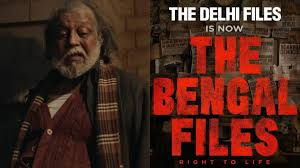
In contrast, the recent surge in politically charged films such as The Kashmir Files, The Kerala Story, and the upcoming The Delhi Files marks a troubling evolution. These films do not merely reflect the political mood—they are part of the machinery shaping it. Wrapped in the language of "truth-telling" and "bringing hidden histories to light," such films often distort facts, cherry-pick incidents, and weaponize trauma.


Now, Vivek Agnihotri, the director of The Kashmir Files, is working on The Bengal Files, a film purportedly based on political violence in West Bengal. Given Agnihotri’s established pattern—where history is viewed through the lens of communal victimhood and ideological warfare—The Bengal Files appears less like investigative storytelling and more like the continuation of hate politics through cinema. The project, unveiled amid political turbulence in Bengal, seems poised to further polarize public opinion in a state already grappling with deep-rooted tensions. Its objective appears less about truth and more about reinforcing a national narrative of siege and division.


Follow the Money: Who’s Funding the Propaganda?

The success of these films isn't accidental—nor is their financing merely artistic. A closer look reveals an intricate ecosystem where ideology, money, and political power work hand in hand.

1. Producers with Political Links

Many of these films are backed by producers with visible or tacit ties to the ruling party.
The Kashmir Files, for example, was co-produced by Zee Studios and Abhishek Agarwal Arts—the latter run by a Hyderabad-based businessman known for his proximity to BJP leaders. The Kerala Story was produced by Vipul Amrutlal Shah, a filmmaker whose public statements often mirror Hindutva rhetoric.

2. Government Patronage as Indirect Funding

No government official writes a cheque—but support comes in subtler, more powerful forms:

  • Tax exemptions granted by BJP-ruled states,
  • Free screenings for students, police, and bureaucrats,
  • Public endorsements by top leaders including the Prime Minister,
  • And amplification by the BJP’s digital ecosystem, giving these films the kind of reach most filmmakers can only dream of.

Such soft backing dramatically reduces costs and guarantees attention—making it a kind of de facto state subsidy.

3. Shadow Funders and Ideological Venture Capital

A number of relatively unknown production houses have suddenly emerged with unexplained funding muscle. These are often linked to:

  • Real estate and mining interests,
  • Businessmen aligned with ruling party agendas,
  • Or shell companies connected to media empires sympathetic to the regime.

While direct evidence is scarce due to opaque financial structures, patterns of political timing and exclusive access to resources strongly suggest orchestrated support.

4. Ideologically Driven Directors

Directors like Vivek Agnihotri, who calls himself a “cultural warrior,” are no longer just storytellers—they are missionaries with a camera. His close appearances with RSS-affiliated organizations and ideological think tanks like India Foundation suggest that these films are not independent creations—they are commissioned narratives. The Bengal Files, in this context, appears not as journalism through art but propaganda through celluloid.


Cognitive Capture: The Mind as a Battlefield

A critical aspect of propaganda films is their ability to bypass critical reasoning. Neuroscience suggests that emotionally charged visuals activate the amygdala—the brain’s fear center—suppressing rational thought and enhancing memory retention. In other words, when a film shocks or angers us, it leaves a deeper impression than a news article or policy paper ever could.

This is particularly dangerous in a society where media literacy is low and cinema remains the most accessible form of mass communication. A citizen who watches a communal propaganda film may not consciously become prejudiced, but the seeds of bias are sown. Repetition, emotional manipulation, and social reinforcement (via WhatsApp forwards, social media memes, or television debates) water those seeds until they blossom into conviction.

What begins as “just a movie” soon becomes the basis of “I heard somewhere,” which hardens into “I know this happened.” The leap from perception to belief is barely noticed.


From Socio-Politics to Geopolitics

The domestic impact of propaganda films is grave, but their geopolitical implications are equally troubling. When films demonize an entire religion or community—be it Muslims in India, immigrants in the U.S., or Uyghurs in China—they don’t just influence internal discourse. They signal to the world a nation’s ideological trajectory.

India, once proud of its pluralism, now finds itself defending against charges of Islamophobia, partly because of the global reach of its domestic narratives. When state-backed or state-endorsed films project a unidimensional nationalism, it affects bilateral relations, diplomatic equations, and even trade alliances.

Moreover, authoritarian regimes have long understood the power of cinema in projecting soft power abroad. Russia, China, and Turkey have invested heavily in period dramas and nationalist blockbusters that export their worldview globally. The battle for narrative supremacy has moved beyond battlefields and boardrooms—it now plays out on Netflix, YouTube, and Prime Video.


The Fragile Viewer: Consent Without Awareness

Perhaps the most insidious feature of propaganda cinema is its subtle violation of the viewer’s consent. When we watch political speeches or campaign ads, we do so with a sense of guardedness, aware that persuasion is the intent. But cinema disarms us. We walk into a theatre seeking entertainment, not ideology. We let our guard down, suspend disbelief, and allow ourselves to be swept away.

This is precisely what makes propaganda films so effective: they do not argue, they hypnotize.

In a healthy democracy, films should provoke thought, not paralyze it. They should ask questions, not issue verdicts. When cinema begins to echo only one kind of nationalism, one kind of history, one kind of heroism—it ceases to be art and becomes artillery.


Conclusion: Between Truth and Trauma

As citizens, we must remain vigilant. Not all films are propaganda, and not all propaganda films wear the mask of nationalism. Sometimes, the bias is subtle—a line here, a stereotype there. Sometimes, it is blatant. But in every case, the effect is cumulative.

We must ask: Who made this film? Who funded it? Why now? Whose version of history is being told? What is being omitted? And what purpose does it serve?

Cinema has the power to heal, to build bridges, to imagine new futures. But when wielded irresponsibly, it can also inflame, divide, and destroy. A nation that treats film as a weapon rather than a mirror will eventually lose sight of its own reflection.


Author: Siddhartha Shankar Mishra is an Advocate at the Supreme Court of India. He writes on law, politics, and culture, often exploring the intersection between power and perception.