Pages

Powered By Blogger
Showing posts with label communalpolarisation. Show all posts

October 01, 2025

Behind the Curtain: Modi as the De Facto RSS SANGRACHALAK


The Hidden Helm: Modi Steering the Sangh


The Rashtriya Swayamsevak Sangh has always projected itself as the ideological fountainhead of the Bharatiya Janata Party and the larger Sangh Parivar. At the centre of this structure is the Sarsanghchalak, portrayed as the supreme guide whose word is final. From Dr Keshav Baliram Hedgewar to M S Golwalkar and later Balasaheb Deoras, the Sarsanghchalak was seen as the soul of the movement. Even in recent decades, when the BJP emerged as a national force, Nagpur remained the ideological compass. Yet in today’s India, that compass has been quietly placed in the Prime Minister’s Office. Narendra Modi, once the humble pracharak who took instructions from Nagpur, has become the real Sarsanghchalak. The guru has been reduced to an accessory, while the disciple has claimed the throne.

From mentor to servant

In the past, the RSS called the shots. The Jan Sangh and later the BJP were seen as political instruments of Nagpur. Atal Bihari Vajpayee, despite his moderate image, never ignored the Sangh leadership. L K Advani built his career on the Ram Janmabhoomi movement which was not simply a political strategy but an RSS designed mass mobilisation. The demolition of the Babri Masjid in 1992, for which Advani later expressed regret, was nonetheless carried out by cadres who took their ideological fuel from the Sangh.

Even Vajpayee, whose government came to power in 1998, had to walk a careful line. He sought to pursue a more inclusive political image but Nagpur always had a say in policy debates. The parent organisation could still discipline its political child. This balance of power kept the RSS as the ideological master and BJP as the obedient offspring.

That equilibrium has collapsed in the Modi era.

Modi’s rise and the shift in control

Narendra Modi’s political journey is deeply rooted in the RSS. He joined as a pracharak in the early 1970s and was deputed to the BJP in the 1980s. His rise in Gujarat was backed by the Sangh network. However, once he became Chief Minister after the 2001 earthquake, Modi demonstrated that he was not going to be just another organisational functionary. The 2002 Gujarat riots cemented his image as a strong leader who could survive criticism from both outside and within. Reports suggest that the then Prime Minister Vajpayee wanted him removed, but the RSS defended him. Ironically, that defence helped Modi build a personal power base that eventually outgrew the organisation.

By the time Modi became Prime Minister in 2014, the RSS had invested heavily in his victory. Lakhs of volunteers campaigned tirelessly to bring the BJP to power. Yet once Modi was in office, the direction of influence reversed. Instead of Nagpur guiding Delhi, Delhi began dictating terms to Nagpur.

Examples of RSS sidelining

Several examples underline this transformation. When demonetisation was announced in 2016, the decision was taken in absolute secrecy. Even senior ministers were caught unaware. The RSS, which traditionally prides itself on being part of major ideological and organisational debates, was left as clueless as the common man standing in ATM queues. Still, instead of questioning, the Sangh issued statements of support.

The abrogation of Article 370 in 2019, though long cherished by the Sangh, was executed entirely as a government plan. The RSS played no role in strategy or timing. It was Modi and Amit Shah who scripted and staged the move. The Citizenship Amendment Act too bore the Modi stamp, with the Sangh again reduced to cheerleading rather than guiding.

Even in electoral strategies, it is Modi’s image that dominates. The RSS cadres may do the ground work, but the central figure is the Prime Minister himself. The Sangh has become a campaigning tool rather than the ideological master.

The silencing of veterans

Perhaps the most striking evidence of Modi’s supremacy over the RSS lies in the treatment of senior leaders. L K Advani, once the face of Hindutva politics and the Sangh’s trusted man, was unceremoniously retired from active politics. Murli Manohar Joshi, a lifelong swayamsevak and scholar, was sidelined. Even Nitin Gadkari, widely respected within the RSS and seen as its natural choice for higher leadership, has been made to walk carefully so as not to appear as a rival to Modi.

In earlier times, the RSS would not have allowed such arbitrary sidelining of its veterans. But today, Nagpur accepts what Delhi dictates.

The symbolic power shift

The RSS still holds its annual Vijayadashami gatherings where the Sarsanghchalak delivers a speech. But those speeches are carefully worded to avoid even mild criticism of the government. They sound less like guiding statements and more like endorsements of policy. The once assertive parent has become a polite follower.

In satire, one might say the RSS is no longer the fountainhead of ideology but the fountain pen, signing wherever Modi points. It is no longer the guiding compass but a ceremonial compass rose drawn on a map that Modi has already charted. The guru claps from the audience while the disciple performs on stage.

Consequences of this reversal

This power shift is not a mere matter of internal hierarchy. It carries serious consequences for Indian democracy. The RSS always claimed that it was above day to day politics, that it provided cultural and moral guidance while the BJP handled governance. If that claim was ever true, it is no longer so. Today, the RSS has outsourced its moral compass to one man’s ego.

The organisation remains silent on issues like growing economic inequality, crony capitalism, farmer distress, and unemployment. It raises selective concerns on matters of social harmony but never questions the government in power. Its autonomy has shrunk into irrelevance. Instead of being the conscience keeper of the BJP, it has become a mere echo chamber.

The irony is bitter. The RSS built the BJP brick by brick, using decades of grassroots work. It mobilised generations of volunteers who lived austere lives for the sake of ideology. Yet today, all that discipline and sacrifice serve one individual’s brand. Narendra Modi is not just the Prime Minister; he has become the de facto Sarsanghchalak. The real shakha is no longer in dusty grounds across India but in the Prime Minister’s rallies, his cabinet meetings, and his digital propaganda machinery.

A cautionary tale

The story of the RSS under Modi is a cautionary tale for any organisation that believes it can control its political offspring. Once a creature of Nagpur, the BJP has now domesticated the very hand that fed it. The puppeteer has become the puppet. The cultural parent has been reduced to a ceremonial relative.

History will judge whether this was an inevitable centralisation of power or a betrayal of the Sangh’s original structure. What is clear is that the RSS today plays second fiddle, and its supposed supremacy is a matter of myth rather than fact.

In blunt terms, the real Sarsanghchalak does not sit in Nagpur. He sits in New Delhi, ruling not only as Prime Minister but as the ideological commander of the Sangh itself.


Author

Advocate Siddhartha Shankar Mishra is a practicing lawyer at the Supreme Court of India and writes on law, politics, and society.

July 20, 2025

How Propaganda Films Hijack the Indian Mind


The Cinematic Blueprint of Political Polarisation


When Joseph Goebbels declared that cinema was one of the most powerful weapons in the arsenal of the state, he was not being hyperbolic. As Nazi Germany perfected the art of propaganda, film became more than a medium of entertainment—it became an instrument of indoctrination. Almost a century later, the template remains eerily relevant. In democracies and autocracies alike, propaganda cinema continues to thrive, shaping public opinion, altering historical memory, and manipulating national consciousness.


The Craft of Conviction

At its core, a propaganda film does not merely present a narrative—it constructs a moral universe. Villains and heroes are painted in broad, unambiguous strokes. Complex socio-political realities are reduced to binary choices: nationalism versus anti-nationalism, civilization versus barbarism, us versus them. When such simplifications are backed by powerful imagery, emotive music, and gripping performances, the impact on the psyche of viewers can be profound.

Propaganda cinema cloaks itself in patriotism and purpose. It portrays dissenters as traitors, minorities as threats, and ideological opponents as enemies of the state. The intention is never just storytelling—it is nation-building, or more aptly, nation-moulding.


Yet, it is important to distinguish between dissent and hate. Not all political cinema is propaganda. Films like Kissa Kursi Ka (1977) and Aandhi (1975) questioned power and critiqued the system, but they did so without vilifying communities or weaponizing religion. They were voices of resistance in the truest democratic sense—satirical, symbolic, and aimed at the abuse of authority, not at inciting societal divisions. Unlike modern propaganda films, these classics did not seek to create an "enemy within." They questioned rulers, not citizens.


The Indian Context: Beyond Entertainment

In contrast, the recent surge in politically charged films such as The Kashmir Files, The Kerala Story, and the upcoming The Delhi Files marks a troubling evolution. These films do not merely reflect the political mood—they are part of the machinery shaping it. Wrapped in the language of "truth-telling" and "bringing hidden histories to light," such films often distort facts, cherry-pick incidents, and weaponize trauma.


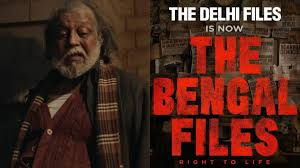
Now, Vivek Agnihotri, the director of The Kashmir Files, is working on The Bengal Files, a film purportedly based on political violence in West Bengal. Given Agnihotri’s established pattern—where history is viewed through the lens of communal victimhood and ideological warfare—The Bengal Files appears less like investigative storytelling and more like the continuation of hate politics through cinema. The project, unveiled amid political turbulence in Bengal, seems poised to further polarize public opinion in a state already grappling with deep-rooted tensions. Its objective appears less about truth and more about reinforcing a national narrative of siege and division.


Follow the Money: Who’s Funding the Propaganda?

The success of these films isn't accidental—nor is their financing merely artistic. A closer look reveals an intricate ecosystem where ideology, money, and political power work hand in hand.

1. Producers with Political Links

Many of these films are backed by producers with visible or tacit ties to the ruling party.
The Kashmir Files, for example, was co-produced by Zee Studios and Abhishek Agarwal Arts—the latter run by a Hyderabad-based businessman known for his proximity to BJP leaders. The Kerala Story was produced by Vipul Amrutlal Shah, a filmmaker whose public statements often mirror Hindutva rhetoric.

2. Government Patronage as Indirect Funding

No government official writes a cheque—but support comes in subtler, more powerful forms:

  • Tax exemptions granted by BJP-ruled states,
  • Free screenings for students, police, and bureaucrats,
  • Public endorsements by top leaders including the Prime Minister,
  • And amplification by the BJP’s digital ecosystem, giving these films the kind of reach most filmmakers can only dream of.

Such soft backing dramatically reduces costs and guarantees attention—making it a kind of de facto state subsidy.

3. Shadow Funders and Ideological Venture Capital

A number of relatively unknown production houses have suddenly emerged with unexplained funding muscle. These are often linked to:

  • Real estate and mining interests,
  • Businessmen aligned with ruling party agendas,
  • Or shell companies connected to media empires sympathetic to the regime.

While direct evidence is scarce due to opaque financial structures, patterns of political timing and exclusive access to resources strongly suggest orchestrated support.

4. Ideologically Driven Directors

Directors like Vivek Agnihotri, who calls himself a “cultural warrior,” are no longer just storytellers—they are missionaries with a camera. His close appearances with RSS-affiliated organizations and ideological think tanks like India Foundation suggest that these films are not independent creations—they are commissioned narratives. The Bengal Files, in this context, appears not as journalism through art but propaganda through celluloid.


Cognitive Capture: The Mind as a Battlefield

A critical aspect of propaganda films is their ability to bypass critical reasoning. Neuroscience suggests that emotionally charged visuals activate the amygdala—the brain’s fear center—suppressing rational thought and enhancing memory retention. In other words, when a film shocks or angers us, it leaves a deeper impression than a news article or policy paper ever could.

This is particularly dangerous in a society where media literacy is low and cinema remains the most accessible form of mass communication. A citizen who watches a communal propaganda film may not consciously become prejudiced, but the seeds of bias are sown. Repetition, emotional manipulation, and social reinforcement (via WhatsApp forwards, social media memes, or television debates) water those seeds until they blossom into conviction.

What begins as “just a movie” soon becomes the basis of “I heard somewhere,” which hardens into “I know this happened.” The leap from perception to belief is barely noticed.


From Socio-Politics to Geopolitics

The domestic impact of propaganda films is grave, but their geopolitical implications are equally troubling. When films demonize an entire religion or community—be it Muslims in India, immigrants in the U.S., or Uyghurs in China—they don’t just influence internal discourse. They signal to the world a nation’s ideological trajectory.

India, once proud of its pluralism, now finds itself defending against charges of Islamophobia, partly because of the global reach of its domestic narratives. When state-backed or state-endorsed films project a unidimensional nationalism, it affects bilateral relations, diplomatic equations, and even trade alliances.

Moreover, authoritarian regimes have long understood the power of cinema in projecting soft power abroad. Russia, China, and Turkey have invested heavily in period dramas and nationalist blockbusters that export their worldview globally. The battle for narrative supremacy has moved beyond battlefields and boardrooms—it now plays out on Netflix, YouTube, and Prime Video.


The Fragile Viewer: Consent Without Awareness

Perhaps the most insidious feature of propaganda cinema is its subtle violation of the viewer’s consent. When we watch political speeches or campaign ads, we do so with a sense of guardedness, aware that persuasion is the intent. But cinema disarms us. We walk into a theatre seeking entertainment, not ideology. We let our guard down, suspend disbelief, and allow ourselves to be swept away.

This is precisely what makes propaganda films so effective: they do not argue, they hypnotize.

In a healthy democracy, films should provoke thought, not paralyze it. They should ask questions, not issue verdicts. When cinema begins to echo only one kind of nationalism, one kind of history, one kind of heroism—it ceases to be art and becomes artillery.


Conclusion: Between Truth and Trauma

As citizens, we must remain vigilant. Not all films are propaganda, and not all propaganda films wear the mask of nationalism. Sometimes, the bias is subtle—a line here, a stereotype there. Sometimes, it is blatant. But in every case, the effect is cumulative.

We must ask: Who made this film? Who funded it? Why now? Whose version of history is being told? What is being omitted? And what purpose does it serve?

Cinema has the power to heal, to build bridges, to imagine new futures. But when wielded irresponsibly, it can also inflame, divide, and destroy. A nation that treats film as a weapon rather than a mirror will eventually lose sight of its own reflection.


Author: Siddhartha Shankar Mishra is an Advocate at the Supreme Court of India. He writes on law, politics, and culture, often exploring the intersection between power and perception.