Pages

Powered By Blogger
Showing posts with label Democracy. Show all posts

January 17, 2026

Educated, Enraged and Engineered: How Digital Politics Is Rewriting Our Minds and Our Laws


Educated, Enraged and Engineered: How Digital Politics Is Rewriting Our Minds and Our Laws

The Education Paradox in the Age of Smartphones

India once believed that education would gradually dissolve prejudice and expand moral imagination. The smartphone age has exposed a troubling paradox. The educated middle class today appears more vulnerable to online communal narratives than the poor who struggle daily for survival. This vulnerability is not accidental. It is psychological, social and carefully cultivated by political communication strategies that understand insecurity better than ideology.

Fear of Falling and the Search for Enemies

The poor remain trapped in the politics of material life. Their anger is directed at prices, wages, healthcare and housing. Their grievances are immediate and visible. The middle class, however, lives in a permanent fear of falling. Employment feels uncertain. Social status feels fragile. Cultural confidence feels threatened. In such an atmosphere, symbolic enemies become easier targets than complex economic structures. Communal identity offers emotional relief by converting anxiety into belonging and grievance into moral superiority.

Echo Chambers of Respectable Prejudice

Social media platforms intensify this psychology. Housing societies, professional groups and alumni networks become ideological echo chambers where opinions are rewarded with approval and aggression is mistaken for courage. Over time, political signalling becomes a social requirement. Silence begins to look suspicious. Nuance appears weak. Extremes become normal.

Degrees Without Critical Training

Education in India has largely remained technical rather than philosophical. It trains people to perform tasks but rarely to question narratives or examine emotional manipulation. This creates a class that is confident in vocabulary but fragile in judgement. Polished propaganda dressed as historical fact and strategic realism circulates easily among people who feel informed but are rarely challenged to reflect on their own assumptions.

Why the Poor Remain Outside Digital Culture Wars

The poor, lacking constant access to ideological performance spaces, remain less invested in symbolic wars. Their anger is local and personal. The middle class anger becomes abstract and ideological, easily redirected toward distant communities and imagined threats. Political campaigns understand this difference well. They offer civilisational pride instead of policy answers, emotional unity instead of economic accountability. In doing so, they transform social anxiety into ideological mobilisation.

Algorithms That Reward Anger Over Accuracy

Misinformation thrives because digital platforms are not designed to reward truth. They are designed to reward engagement. Fear and anger generate more clicks than calm explanation. A lie can be dramatic, simple and emotionally satisfying. A correction must be cautious, complex and patient. In a culture trained to scroll, outrage always wins.

Custom Made Realities and Manufactured Loyalty

Algorithms amplify what keeps users emotionally involved. Once a person interacts with sensational content, similar narratives are pushed repeatedly. Gradually, people are surrounded by confirming messages. Reality becomes customised. Dissent appears dangerous. Skepticism looks like betrayal.

Belonging Becomes More Important Than Being Right

Political actors exploit this architecture deliberately. Instead of debating governance, they circulate identity driven stories that activate instinctive loyalty. Even when these stories are later disproved, the emotional impression remains. People remember how the message made them feel, not whether it was accurate. Sharing such content brings social approval. Correcting it brings hostility. Over time, truth becomes socially expensive.

From Digital Rage to Institutional Pressure

This cycle of outrage does not remain limited to screens. It enters police stations, courtrooms and legislative discourse. Law in a constitutional democracy is meant to operate through evidence, procedure and restraint. But institutions are staffed by human beings who exist within political and social climates.

Policing for Visibility Not Justice

Policing becomes reactive to publicity. High profile cases receive swift action while quieter injustices remain ignored. Arrests begin to serve symbolic reassurance rather than investigative necessity. Due process starts appearing as delay. Caution is interpreted as complicity.

Courts Under the Shadow of Popular Expectation

Courts, although constitutionally independent, do not function in social isolation. Judges read newspapers and face public discourse. When verdicts are expected to satisfy ideological camps, neutrality itself becomes controversial. Judicial reasoning is evaluated through political lenses rather than legal coherence.

The Slow Erosion of Constitutional Culture

This weakens constitutional culture. Rights exist to protect unpopular individuals and minorities. But when public emotion becomes the primary measure of justice, safeguards begin to look like obstacles. Law risks becoming a reflection of crowd morality instead of a restraint upon it.

Resistance Begins in the Mind

In such an environment, the survival of democracy depends not only on institutions but also on citizens who resist psychological manipulation. Mental independence becomes civic duty.

Slow Down the Emotional Reflex

The first form of resistance is slowing down emotional reaction. Anger is the preferred currency of digital platforms. Pausing before sharing or responding disrupts the cycle of impulsive amplification.

Break the Bubble of Confirmation

The second is diversifying information sources. Reading across ideological boundaries weakens the illusion that one narrative represents absolute truth. Exposure to complexity reduces susceptibility to propaganda.

Do Not Turn Ideology Into Identity

The third is separating personal identity from political slogans. When ideology becomes self worth, disagreement feels like personal attack. This emotional fusion makes manipulation easy and reconciliation impossible.

Save Relationships to Save Society

Preserving friendships and family relationships across political differences is not weakness. It is democratic resilience. When every disagreement becomes ideological warfare, society loses its capacity for empathy and dialogue.

Humility as Democratic Strength

Finally, resisting polarisation requires humility. Accepting the possibility of being wrong weakens propaganda which thrives on absolute certainty. Doubt is not betrayal. It is democratic maturity.

The Real Battle of Our Time

The real conflict of our time is not between religions or parties. It is between reflection and reaction, between thought and impulse, between citizenship and digital herding. Digital technology did not invent prejudice, but it has industrialised it. And when prejudice becomes profitable, politics stops seeking solutions and starts manufacturing enemies.

Democracy survives not only through elections and courts, but through citizens who refuse to surrender their minds to emotional automation. Algorithms may control screens, but they do not have to control conscience. That choice still remains with us.

Author Introduction


Siddhartha Shankar Mishra is an advocate at the Supreme Court of India and a commentator on law, politics and society. His writings blend legal insight with social critique and aim to provoke reflection on power, justice and public conscience.

July 20, 2025

How Propaganda Films Hijack the Indian Mind


The Cinematic Blueprint of Political Polarisation


When Joseph Goebbels declared that cinema was one of the most powerful weapons in the arsenal of the state, he was not being hyperbolic. As Nazi Germany perfected the art of propaganda, film became more than a medium of entertainment—it became an instrument of indoctrination. Almost a century later, the template remains eerily relevant. In democracies and autocracies alike, propaganda cinema continues to thrive, shaping public opinion, altering historical memory, and manipulating national consciousness.


The Craft of Conviction

At its core, a propaganda film does not merely present a narrative—it constructs a moral universe. Villains and heroes are painted in broad, unambiguous strokes. Complex socio-political realities are reduced to binary choices: nationalism versus anti-nationalism, civilization versus barbarism, us versus them. When such simplifications are backed by powerful imagery, emotive music, and gripping performances, the impact on the psyche of viewers can be profound.

Propaganda cinema cloaks itself in patriotism and purpose. It portrays dissenters as traitors, minorities as threats, and ideological opponents as enemies of the state. The intention is never just storytelling—it is nation-building, or more aptly, nation-moulding.


Yet, it is important to distinguish between dissent and hate. Not all political cinema is propaganda. Films like Kissa Kursi Ka (1977) and Aandhi (1975) questioned power and critiqued the system, but they did so without vilifying communities or weaponizing religion. They were voices of resistance in the truest democratic sense—satirical, symbolic, and aimed at the abuse of authority, not at inciting societal divisions. Unlike modern propaganda films, these classics did not seek to create an "enemy within." They questioned rulers, not citizens.


The Indian Context: Beyond Entertainment

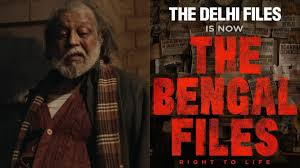
In contrast, the recent surge in politically charged films such as The Kashmir Files, The Kerala Story, and the upcoming The Delhi Files marks a troubling evolution. These films do not merely reflect the political mood—they are part of the machinery shaping it. Wrapped in the language of "truth-telling" and "bringing hidden histories to light," such films often distort facts, cherry-pick incidents, and weaponize trauma.


Now, Vivek Agnihotri, the director of The Kashmir Files, is working on The Bengal Files, a film purportedly based on political violence in West Bengal. Given Agnihotri’s established pattern—where history is viewed through the lens of communal victimhood and ideological warfare—The Bengal Files appears less like investigative storytelling and more like the continuation of hate politics through cinema. The project, unveiled amid political turbulence in Bengal, seems poised to further polarize public opinion in a state already grappling with deep-rooted tensions. Its objective appears less about truth and more about reinforcing a national narrative of siege and division.


Follow the Money: Who’s Funding the Propaganda?

The success of these films isn't accidental—nor is their financing merely artistic. A closer look reveals an intricate ecosystem where ideology, money, and political power work hand in hand.

1. Producers with Political Links

Many of these films are backed by producers with visible or tacit ties to the ruling party.
The Kashmir Files, for example, was co-produced by Zee Studios and Abhishek Agarwal Arts—the latter run by a Hyderabad-based businessman known for his proximity to BJP leaders. The Kerala Story was produced by Vipul Amrutlal Shah, a filmmaker whose public statements often mirror Hindutva rhetoric.

2. Government Patronage as Indirect Funding

No government official writes a cheque—but support comes in subtler, more powerful forms:

  • Tax exemptions granted by BJP-ruled states,
  • Free screenings for students, police, and bureaucrats,
  • Public endorsements by top leaders including the Prime Minister,
  • And amplification by the BJP’s digital ecosystem, giving these films the kind of reach most filmmakers can only dream of.

Such soft backing dramatically reduces costs and guarantees attention—making it a kind of de facto state subsidy.

3. Shadow Funders and Ideological Venture Capital

A number of relatively unknown production houses have suddenly emerged with unexplained funding muscle. These are often linked to:

  • Real estate and mining interests,
  • Businessmen aligned with ruling party agendas,
  • Or shell companies connected to media empires sympathetic to the regime.

While direct evidence is scarce due to opaque financial structures, patterns of political timing and exclusive access to resources strongly suggest orchestrated support.

4. Ideologically Driven Directors

Directors like Vivek Agnihotri, who calls himself a “cultural warrior,” are no longer just storytellers—they are missionaries with a camera. His close appearances with RSS-affiliated organizations and ideological think tanks like India Foundation suggest that these films are not independent creations—they are commissioned narratives. The Bengal Files, in this context, appears not as journalism through art but propaganda through celluloid.


Cognitive Capture: The Mind as a Battlefield

A critical aspect of propaganda films is their ability to bypass critical reasoning. Neuroscience suggests that emotionally charged visuals activate the amygdala—the brain’s fear center—suppressing rational thought and enhancing memory retention. In other words, when a film shocks or angers us, it leaves a deeper impression than a news article or policy paper ever could.

This is particularly dangerous in a society where media literacy is low and cinema remains the most accessible form of mass communication. A citizen who watches a communal propaganda film may not consciously become prejudiced, but the seeds of bias are sown. Repetition, emotional manipulation, and social reinforcement (via WhatsApp forwards, social media memes, or television debates) water those seeds until they blossom into conviction.

What begins as “just a movie” soon becomes the basis of “I heard somewhere,” which hardens into “I know this happened.” The leap from perception to belief is barely noticed.


From Socio-Politics to Geopolitics

The domestic impact of propaganda films is grave, but their geopolitical implications are equally troubling. When films demonize an entire religion or community—be it Muslims in India, immigrants in the U.S., or Uyghurs in China—they don’t just influence internal discourse. They signal to the world a nation’s ideological trajectory.

India, once proud of its pluralism, now finds itself defending against charges of Islamophobia, partly because of the global reach of its domestic narratives. When state-backed or state-endorsed films project a unidimensional nationalism, it affects bilateral relations, diplomatic equations, and even trade alliances.

Moreover, authoritarian regimes have long understood the power of cinema in projecting soft power abroad. Russia, China, and Turkey have invested heavily in period dramas and nationalist blockbusters that export their worldview globally. The battle for narrative supremacy has moved beyond battlefields and boardrooms—it now plays out on Netflix, YouTube, and Prime Video.


The Fragile Viewer: Consent Without Awareness

Perhaps the most insidious feature of propaganda cinema is its subtle violation of the viewer’s consent. When we watch political speeches or campaign ads, we do so with a sense of guardedness, aware that persuasion is the intent. But cinema disarms us. We walk into a theatre seeking entertainment, not ideology. We let our guard down, suspend disbelief, and allow ourselves to be swept away.

This is precisely what makes propaganda films so effective: they do not argue, they hypnotize.

In a healthy democracy, films should provoke thought, not paralyze it. They should ask questions, not issue verdicts. When cinema begins to echo only one kind of nationalism, one kind of history, one kind of heroism—it ceases to be art and becomes artillery.


Conclusion: Between Truth and Trauma

As citizens, we must remain vigilant. Not all films are propaganda, and not all propaganda films wear the mask of nationalism. Sometimes, the bias is subtle—a line here, a stereotype there. Sometimes, it is blatant. But in every case, the effect is cumulative.

We must ask: Who made this film? Who funded it? Why now? Whose version of history is being told? What is being omitted? And what purpose does it serve?

Cinema has the power to heal, to build bridges, to imagine new futures. But when wielded irresponsibly, it can also inflame, divide, and destroy. A nation that treats film as a weapon rather than a mirror will eventually lose sight of its own reflection.


Author: Siddhartha Shankar Mishra is an Advocate at the Supreme Court of India. He writes on law, politics, and culture, often exploring the intersection between power and perception.


June 19, 2025

Ctrl+Alt+Sangh: Rebooting India Through Digital Hate


In the age of digital democracy, political power is as much about perception as it is about policy. No party in India has understood—and exploited—this reality better than the Bharatiya Janata Party (BJP). At the centre of its electoral juggernaut lies a carefully engineered, tightly coordinated, and ideologically committed force: the BJP/RSS IT Cell.

The hypothesis that dismantling this IT infrastructure could destabilize or even "finish" the BJP is not merely a provocation—it invites a deeper examination of how information ecosystems, online propaganda, and narrative warfare have reshaped Indian politics. To understand the extent of this digital grip, one must dissect the genesis, functioning, and impact of this formidable machinery.

The BJP IT Cell was founded in 2007 by Prodyut Bora. During the campaign for the 2004 Indian general election, the BJP had already promoted the India Shining slogan and used around 5% of its campaign budget on texts and pre-recorded phone calls to reach voters. The BJP orchestrates online campaigns through its social media cell to intimidate perceived government critics. Sadhavi Khosla, https://caravanmagazine.in/vantage/sadhavi-khosla-bjp-social-media-trolls a BJP cyber-volunteer in the BJP IT Cell, said that the organisation disseminated misogyny, Islamophobia and hatred. The network of volunteers of BJP take instructions from the BJP IT Cell and two affiliated organisations to troll users who are critical of the BJP. Journalists and Indian film actors are also among their targets.

Swati Chaturvedi’s explosive book I Am a Troll pulls back the curtain on this digital war room. Drawing on firsthand testimony, it exposes how Hindutva’s digital foot soldiers manufacture consent, silence dissent, and spread venom under the veneer of patriotism. The book offers rare insight into the coordinated machinery behind the façade of spontaneous online support, revealing the orchestrated hypocrisy behind self-proclaimed nationalist trolling.


In November 2015, Aamir Khan, an Indian Muslim actor, expressed concern about rising intolerance in India in response to political events that included violent attacks against Muslims and intellectuals, and the absence of swift or strong condemnation from the country's ruling BJP government. Khosla said that BJP responded with an online campaign through its social media cell to intimidate Khan. Modi supporters bombarded the company where Khan was spokesperson with orders and later cancelled them, resulting in the company distancing itself from Khan, though a planned boycott of his film Dangal by BJP supporters proved unsuccessful. Derek O'Brien, a member of Parliament, raised the topic of online hate in the Rajya Sabha. He questioned why Narendra Modi followed cyber-bullies on social media and said, "We are mainstreaming hate". He also asked if the Modi administration would issue an advisory asking government officials to stop following Twitter users that regularly send abusive messages and obscenities. The government did not respond to this request.

In December 2020, Twitter took restrictive action against Amit Malviya, IT Cell in charge, and tagged his posts as 'manipulated media'. This was the first time Twitter took restrictive action against an Indian political personality. Malviya had posted an edited video of an incident from the 2020–2021 Indian farmers' protest that violated Twitter policy towards fighting the spread of doctored media.

An investigation by the Indian media watchdog Newslaundry revealed the organisational structure of the IT Cell: The state IT cell has 25 members in the core team with Rai as its head. Each regional centre had 20 members and a team of 15 handled IT at each of the 92 districts. Seven-member teams worked at the block levels. At the regional, district and Assembly level, BJP had approximately 5,000 workers. A separate team of 20 professionals – including technicians, designers, and cartoonists – created the desired content for the party.

JPS Rathore, a member of the UP-BJP's IT Cell described the motives of the organisation as follows:

"Our aim was to capture the mind of the voter. To message them night and day. Whenever they look, they should see us, hear our message. (Humari rajniti thi ki chunav ke pehle voter ke dimag ko capture kar lo. Subeh–shaam message bhejo. Jab dekhe, humara chehra dekhe, humari baat sune)."

The BJP’s IT Cell is not a conventional public relations team. It is a hybrid of a media company, a political war room, a troll factory, and a propaganda engine. Staffed by full-time professionals and supported by an army of volunteers and sympathizers, the IT Cell is organized in a hierarchical fashion—much like a paramilitary force. Every message, meme, and talking point is part of a broader narrative strategy.

From the national headquarters in Delhi to WhatsApp groups at the booth level, the digital operations of the BJP are both top-down and hyper-local. They deploy micro-targeting techniques using voter data, behavioral analytics, and caste/religious demographics to tailor their content to specific audiences. This is not just communication—this is psychological warfare.

Speed is everything in digital politics. The IT Cell specializes in flooding platforms with content the moment a controversy breaks. While the opposition drafts a press release, the BJP's ecosystem already has a dozen memes, hashtags, and viral videos in circulation. These are amplified by influencers, fake accounts, bots, and media channels aligned with the ruling ideology.

The emphasis is not on truth but on traction. A lie that trends becomes a truth in perception. By the time it is fact-checked, it has already served its purpose.

The BJP’s digital strategy transcends mere storytelling. It is about defining what counts as reality. Whether it's rewriting historical narratives, distorting opposition statements, or creating fear about minorities, the IT Cell manufactures consent and outrage with industrial efficiency. WhatsApp forwards that mix half-truths with communal innuendo have become a key mode of voter persuasion in rural India.

The cumulative effect is toxic: polarization, disinformation, and an erosion of trust in journalism, institutions, and even science. Critics are routinely targeted through doxxing, trolling, or worse—often backed by semi-official dog whistles.

No political figure has benefited more from digital myth-making than Narendra Modi. The IT Cell has elevated him from a regional leader to a cult-like global statesman. His image—carefully curated, selectively photographed, and algorithmically promoted—is the crown jewel of the BJP’s digital empire.

Criticism of Modi is not treated as political disagreement but as heresy. This deification, enabled by relentless digital campaigning, has created a leader beyond reproach—a dangerous condition in any democracy.

Elections in India today are as much about mobilizing narratives as mobilizing voters. The BJP’s IT Cell has played a crucial role in shaping the outcome of almost every major election in the last decade—from Uttar Pradesh and Bihar to Assam and Karnataka.

The key lies in narrative control. Whether it's invoking nationalism after Balakot, spinning economic data post-demonetization, or justifying lockdown chaos during COVID-19, the IT Cell has turned crisis into opportunity through rapid reframing.

Would the BJP collapse if its IT Cell were dismantled? Not instantly. The party has deep-rooted ideological bases, a strong organizational network (the RSS), and powerful funders. But it would lose its greatest strategic advantage: the ability to control perception in real time.

In a post-IT Cell landscape, the BJP would have to confront unfiltered public opinion, media scrutiny, and grassroots backlash without the shield of curated narratives. Opposition voices would regain space. Independent journalism could flourish. Civil society would breathe freer.

In short, the party would have to do politics the old-fashioned way: with accountability.

The conversation is not merely about one party. The BJP's IT Cell is the model now being emulated by regional parties, corporate lobbies, and even foreign actors. It represents the broader crisis of digital democracy: where the speed of lies outpaces the slowness of truth.

To destroy the BJP’s IT Cell is not to silence a party, but to dismantle a machine that has subverted democratic deliberation. It is to restore balance to a public sphere overwhelmed by hate, hyperbole, and half-truths.

Every empire has its Achilles' heel. For the BJP, it is its digital invincibility. Strip away the algorithms, expose the misinformation, and the party is forced to stand on the merit of its policies and the integrity of its governance.

This is not a call for censorship but for civic resistance—a pushback against a weaponized narrative industry. Until then, the BJP's IT Cell remains its greatest asset—and Indian democracy's most urgent challenge.

In the digital age, the BJP’s IT Cell operates as the nerve centre of its political power—crafting narratives, spreading disinformation, and weaponizing social media to manufacture consent and crush dissent. From micro-targeted propaganda to coordinated trolling armies, this machinery distorts reality, fuels polarization, and elevates a cult-like mythology around Narendra Modi. While deeply rooted in organizational strength, the BJP’s strategic dominance hinges on controlling perception online. Exposing and dismantling this network is essential not just to challenge one party, but to reclaim the integrity of Indian democracy itself.

The BJP’s digital war room is more than just a campaign tool—it’s the algorithmic fortress that shields a fragile political empire built on curated myths and manufactured outrage. To unplug this machine is not to silence a voice but to revive a democratic discourse smothered under waves of digital deceit. Until then, the IT Cell remains the Sangh’s most lethal weapon, rewriting India’s narrative with a click and a troll. It’s time for citizens, journalists, and institutions to reboot their resistance—not with censorship, but with relentless fact, fearless accountability, and unyielding truth. Because in the kingdom of digital hate, only an awakened electorate can break the code.


About the Author

Siddhartha Shankar Mishra is an Advocate at the Supreme Court of India. He writes on law, politics, and society with a voice that blends satire and truth.

May 20, 2025

The Business of Belief: How Faith, Nationalism, and Welfare Were Rebranded for Power


The RSS today looks less like a cultural organisation and more like a Brahmin-Baniya club that knows how to sell ideas like goods in a market. Over the last decade, it has perfected the art of packaging ideology with the finesse of a corporate campaign. Words like “Bharatiya”, “Hindutva”, and even the sacred name of Lord Ram have been turned into political commodities—marketed with emotional appeal, devoid of spiritual depth, and served with electoral intent. Faith has become a business model, and government schemes are sold with a religious sticker on them.

Many of these schemes, ironically, were conceived during Congress regimes but have been rebranded under glossy saffron labels. Initiatives for financial inclusion, rural housing, and public health have been remarketed with catchy slogans like #ModiHaiTohMumkinHai and Sabka Saath, Sabka Vikas—often with minor tweaks and maximum media mileage. The difference? Congress lacked marketing; the BJP mastered it. Wrapped in a saffron version of Bharatiyata, these repackaged schemes are designed to touch the emotional nerves of a largely unsuspecting population, turning governance into spectacle.

The Constitution guarantees freedom of religion—not its franchising. But that distinction is being deliberately erased. In today’s India, beliefs are marketed like brands, governance is sold like faith, and nationalism is peddled like a loyalty subscription. The BJP IT cell, meanwhile, has done a phenomenal job manufacturing and spreading narratives laced with nationalism, creating a digital universe where they are the only patriots and everyone else is conveniently labelled anti-national.

But marketing alone doesn’t move mountains. What makes this political rebranding so effective is the carefully constructed echo chamber that sustains it. A large section of the mainstream media has shed its role as the fourth estate and become the extended PR arm of the ruling dispensation. Prime-time news is no longer about facts or holding power accountable. It has become a circus of manufactured outrage, where anchors shout down dissenters and amplify distraction. While joblessness, inflation, and agrarian distress silently deepen, our television screens remain lit with debates on temples, films, and communal flashpoints.

This sustained diversion would not be possible without the passive complicity—or active abdication—of institutions meant to uphold constitutional order. The judiciary, once revered as the last refuge of the common citizen, now walks a delicate line between caution and calculated delay. Petitions concerning civil liberties, electoral malpractices, and democratic rights linger in cold storage, while cases that suit political interests are heard with lightning speed. The once-mighty Supreme Court now risks appearing selective, if not submissive.

The Election Commission, constitutionally mandated to ensure free and fair elections, too appears increasingly uneven in its scrutiny. While opposition leaders are often reprimanded for minor code violations, blatant breaches by ruling party figures are either ignored or brushed aside. The neutrality that once lent credibility to our democratic process now appears compromised by convenience.

This slow institutional drift has had a chilling effect on civil society. Voices of dissent are not just discredited—they are criminalised. Journalists, students, activists, and even comedians are hounded for questioning the state. The line between criticism and sedition has blurred. In such a climate, even silence becomes an act of resistance.

And then there are the voters—the ordinary citizens whose emotions are constantly manipulated by appeals to religion, caste, and nationalism. It’s not that the public is unaware; it’s that the noise is too loud, the propaganda too persistent, and the choices too narrow. When every election is framed as a battle for civilisation, it becomes harder to speak of roads, schools, or jobs. The voter is offered mythology, not manifesto.

India is not just being governed—it is being marketed. Faith, governance, and identity have all been brought under a single brand strategy. The real danger isn’t just the misuse of religion for politics, but the normalisation of it. When belief becomes business, and business becomes ballot, democracy loses both its meaning and its soul.

In times like these, the citizen must remain alert, not just to what is being said—but to how it's being sold.


About the Author:

Siddhartha Mishra is an Advocate at the Supreme Court of India. He writes on law, politics, and society with a focus on constitutional values, civil liberties, and the misuse of power. He believes that satire is not a style—but a form of resistance.

Email : - ssmishra33@gmail.com